
Topic 3 of 5
The neuropsychobiological model of disease
The brain processes our experiences and coordinates bodily responses to the situation at hand. At the same time, it continuously receives information from the body. These interactions help explain how demands affect us and how regulation contributes to health and disease.
The brain and body continuously influence one another.
The neuropsychobiological model of disease brings together physical characteristics, living conditions and personal experience. It describes possible pathways through which these influences contribute to the development and course of disease. The connections between the brain, autonomic nervous system, hormones and immune system are central to this approach. Their importance in an individual case depends on the disease and the circumstances.
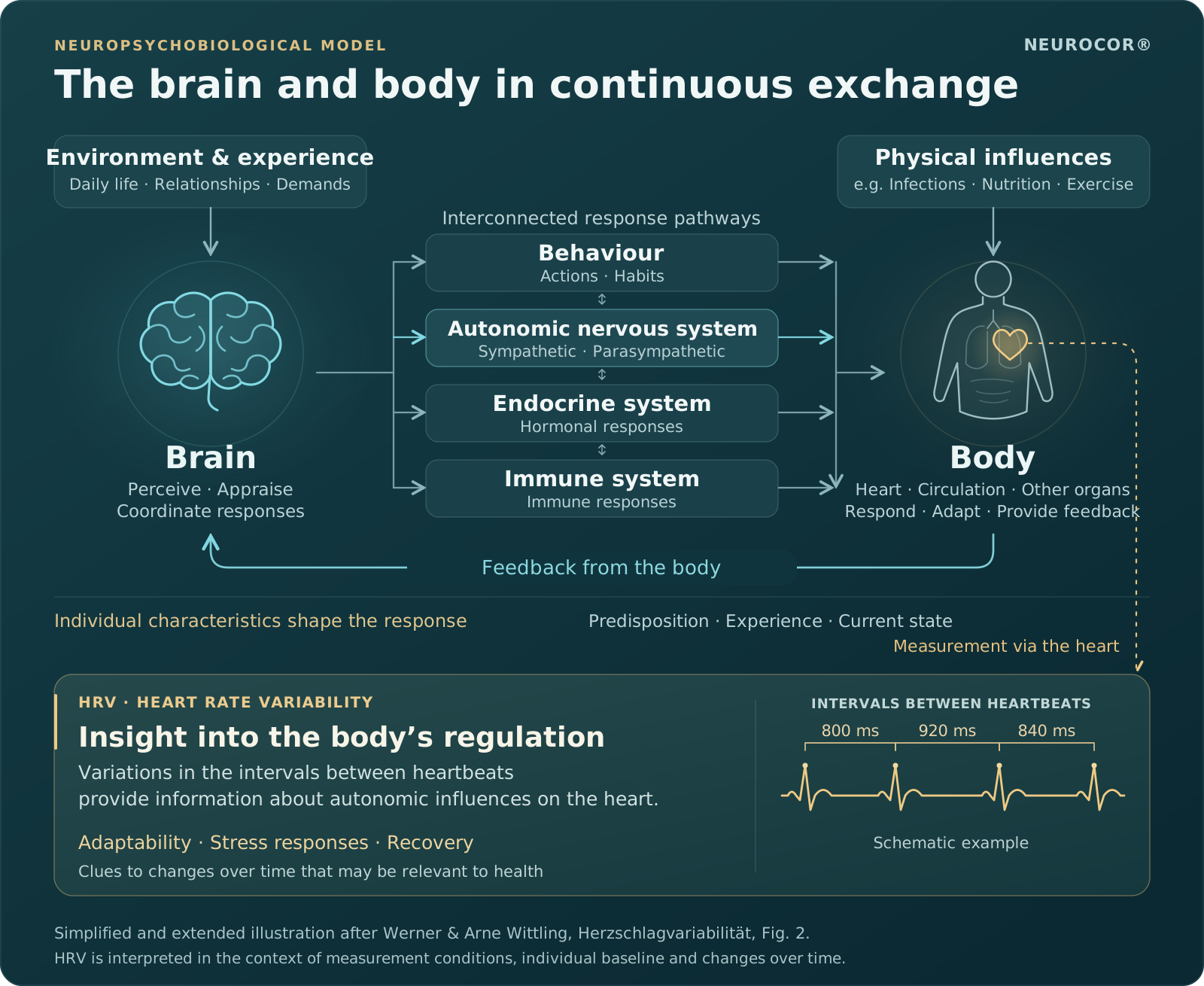 Enlarge diagram
For example, anticipating a difficult conversation can make the heart beat faster. The brain appraises the situation and prepares the body for it. We may also notice a pounding heart or a change in breathing. These bodily sensations can, in turn, influence how we experience the situation. The response develops through a continuing exchange.
How the brain brings circumstances and bodily state together
Several connected brain regions form the central autonomic network. They include areas of the cerebral cortex, the amygdala, the hypothalamus and the brainstem. They process information from the environment alongside signals from the body, including information about blood pressure, breathing and chemical conditions in the blood.
This information helps coordinate bodily responses. When we climb stairs, for example, the heart, circulation and energy supply need to meet greater demands. Feedback from the organs indicates how conditions in the body are changing and helps adjust the response. The meaning of a situation also matters: a familiar task may evoke a different response from one that feels unfamiliar or threatening.
Nerves, hormones and the immune system work together
Nerve signals can change organ function rapidly. Through hormonal pathways, the brain also influences processes whose effects may last longer. One example is the hormonal stress response: the hypothalamus in the brain sends a signal to the pituitary gland. The pituitary then stimulates the adrenal cortex to release cortisol. Feedback within this pathway helps regulate the response.
The immune system is also involved. Neural and hormonal signals can influence immune responses, while immune messengers send information back to the brain. These processes unfold at different rates. Heart rate and breathing may therefore begin to settle while hormonal or immune changes are still continuing.
How sympathetic and parasympathetic influences work together
The sympathetic nervous system helps prepare the body for increased demands. Parasympathetic influences support digestive functions and can slow the heart rate. The effects of both systems depend on the organ involved and the task at hand.
Their activity does not always change in opposite directions. A stronger sympathetic influence may occur alongside either a stronger or a weaker parasympathetic influence. Two questions therefore need to be considered separately: how pronounced is each influence, and what is the relationship between them? A similar relationship can occur at very different levels of activity.
The ability to respond to change also matters. Low activity may be appropriate at rest. When demands increase, the body needs to provide the required output and then adjust again as those demands change.
How our research led to this model
Werner Wittling investigated how the two cerebral hemispheres contribute to the regulation of bodily processes. An experimental study published in 1998, using film scenes presented to one side of the visual field, reported a greater contribution of the left hemisphere to parasympathetic modulation of the heart. Studies of this kind shaped our research into the brain–heart connection. [2]
Werner and Arne Wittling later brought these and other findings together in a model of complementary central response systems. The model connects results from different studies into a broader explanation. Individual experiments establish particular relationships under their specific experimental conditions. An ordinary HRV recording therefore cannot identify a person’s dominant hemisphere or a functional disturbance in a particular brain region.
Disease and regulation influence one another
Persistent demands can alter bodily regulation. In the other direction, disease, inflammation, pain and medication can affect autonomic responses and experience. Sleep, physical activity and other behaviours also contribute. Predispositions and living conditions may help explain why people respond differently to similar demands.
The model therefore considers several possible influences and feedback processes. The involvement of psychosocial factors does not imply personal blame or make physical symptoms any less real. The task is to establish which processes are interacting in that person’s circumstances. HRV can contribute information about cardiac regulation. Medical history, physical findings and other assessments are also needed to understand the individual situation.
Sources and further reading
- Wittling, W. & Wittling, R. A. (2012). Herzschlagvariabilität: Frühwarnsystem, Stress- und Fitnessindikator. Eichsfeld. ISBN 9783935782166.
Further reading in the book: the introduction to Part A and Chapters 1, 2.9 and 3–4 on central control, complementary regulatory systems and autonomic activity.
- Wittling, W., Block, A., Genzel, S., & Schweiger, E. (1998). Hemisphere asymmetry in parasympathetic control of the heart . Neuropsychologia, 36, 461–468.