
Science & methods

Our own research.
Our own HRV analysis.

We develop HRV methods and calculate the parameters used in scientific studies. This experience, alongside research into the connection between brain and body, shapes the next ANS Explorer generation.

Psychophysiology

Current research

How stable is vagally mediated HRV over a year?

In a scientific collaboration with the research group of Dr. Magdalena K. Wekenborg at the Else Kröner Fresenius Center for Digital Health at TU Dresden, the temporal stability of vagally mediated heart rate variability was investigated over a one-year period.

NEUROCOR performed the HRV calculations for this joint research study, contributing its longstanding expertise in HRV analysis.

Temporal stability of vagally-mediated heart rate variability over a one-year period: A latent state-trait examination

DOI: 10.1111/psyp.70445

Our scientific roots

Rooted in university neuroscience research.

Our scientific roots lie in research led by Prof. Dr. Werner Wittling into functional brain asymmetry and the central regulation of bodily processes. A foundational paper from 1998 investigated the different contributions of the cerebral hemispheres to parasympathetic cardiac control. These studies provided the scientific context from which our own HRV methods and analytical technologies emerged.

Collaborative research

Specific questions.
Our own analytical contribution.

Dresden Burnout StudySince 2015Long-term research programme

Autonomic regulation and exhaustion over time.

Since 2015, the Dresden Burnout Study has investigated how stress and exhaustion develop over the years. Established at TU Dresden under the leadership of Prof. Dr. Clemens Kirschbaum, the research programme combines repeated surveys with biological assessments, including heart rate variability measurements.

The selected publications by Dr. Magdalena K. Wekenborg and the collaborating research team examine associations between autonomic cardiac regulation and exhaustion. Our analytical technology, NEUROCOR® precisionHRV, was used for the HRV analyses in each of these studies – most recently for the 2025 assessment wave.

View selected publications and findings

Selected publications from the longitudinal study

The following studies examine selected assessment points; they do not cover the full duration or all assessments of the DBS.

Published in 2019

Two assessments approximately one year apart

167 participants were studied approximately one year apart. Lower initial HRV was associated with greater subsequent burnout symptoms and emotional exhaustion. In the reverse direction, emotional exhaustion was associated with a later decline in HRV.

Full citation

Wekenborg MK, Hill LK, Thayer JF, Penz M, Wittling RA, Kirschbaum C (2019). The Longitudinal Association of Reduced Vagal Tone With Burnout. Psychosomatic medicine, 81(9), 791-798.

Original publication ↗

Published in 2022

Analysis of four assessment waves: 2015–2018

The analysis included 378 participants who had attended at least two of the four annual biomarker assessments conducted between 2015 and 2018. Higher vagally mediated HRV predicted lower subsequent exhaustion in the statistical model; the reverse direction did not show a corresponding association.

Full citation

Wekenborg MK, Schwerdtfeger A, Rothe N, Penz M, Walther A, Kirschbaum C, Thayer JF, Wittling RA, Hill LK (2022). Determining the direction of prediction of the association between parasympathetic dysregulation and exhaustion symptoms. Scientific reports, 12(1), 10648.

Original publication ↗

Further assessments and analyses extend the research programme beyond the observation periods presented here.

Both analyses draw on the Dresden longitudinal programme and examine temporal relationships using different analytical approaches. The observations provide evidence about temporal relationships, not an individual burnout diagnosis or proof of causation.

Our team performed the complete HRV calculations. Data collection, study leadership and statistical modelling formed part of the research collaboration.
Journal of Clinical Medicine9.550working adults · 19 study sites

9,550 people. 19 sites. HRV analysis with NEUROCOR.

What can autonomic cardiac regulation reveal about health risks?

We investigated this question together with Prof. Dr. Joachim E. Fischer and an international research team using data from the Mannheim Industrial Cohort Study. The work focused on associations between heart rate variability and blood pressure, glucose and lipid metabolism, and inflammatory markers.

Our own analysis technology was used for the HRV analyses: NEUROCOR® precisionHRV.

Study and findings in detail

Published in 2019, this proof-of-concept study used cross-sectional analyses to examine whether low vagally mediated HRV was associated with elevated inflammatory, glucose, lipid and blood-pressure risk markers. It found such associations and explored possible cut points.

Full citation

Jarczok MN, Koenig J, Wittling A, Fischer JE, Thayer JF (2019). First Evaluation of an Index of Low Vagally-Mediated Heart Rate Variability as a Marker of Health Risks in Human Adults: Proof of Concept. Journal of clinical medicine, 8(11), E1940.

Original publication ↗

NEUROCOR® precisionHRV

Our own analysis technology.
Patented.

Since 1999, we have been refining HRV analysis down to its mathematical and physical details. Our NEUROCOR® precisionHRV algorithm brings this development work together in an analysis method of our own for precise calculation of heart rate variability—from heartbeat intervals through to frequency-domain spectral analysis.

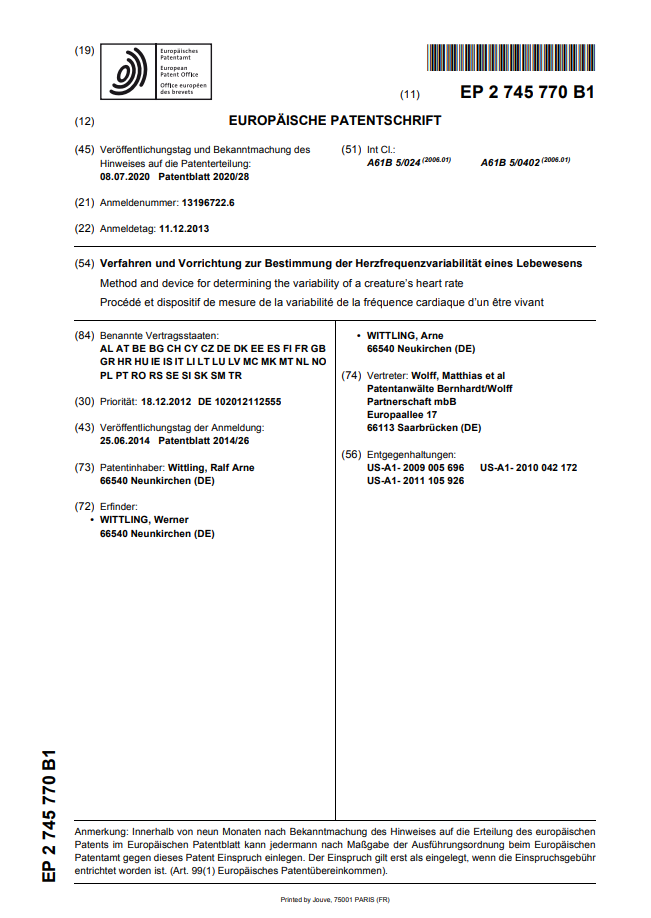
The analysis method developed by Werner and Arne Wittling was granted European patent EP2745770B1.

EUROPEAN PATENTEP 2 745 770 B1

Original HRV methods.
Publicly documented development.

Front page of European patent specification EP 2 745 770 B1.
Analysis methods in detail
  1. 01

    Signal preparation

    Handle unsuitable heartbeat intervals in their temporal and respiratory context.

  2. 02

    Dynamic resampling

    Generate a uniformly sampled time series. The document describes cubic splines and a grid whose length is a power of two.

  3. 03

    Trend and window

    Account for slow trends and edge effects in a finite recording. Coordinate the time grid, weighting and normalisation.

  4. 04

    Spectral assignment

    Assign calculated spectral values to discrete frequency intervals, known as bins, and account for them when summing spectral power.

Further research applications

Selected studies using NEUROCOR.

Examples of how our methods and systems have been used: the following studies represent a selection across research areas, from work-related stress and sleep to metabolism and exhaustion.

Scientific consistency across the years.

Longitudinal studies depend on HRV data being analyzed using consistent, documented methods across all measurement points. That is why we preserve established analysis configurations and algorithm versions, even as we continuously advance ANS Explorer and its analytical methods.

Research in book form

Decades of research.
A deeper understanding.
Herzschlagvariabilität

Our German-language book “Herzschlagvariabilität: Frühwarnsystem, Stress- und Fitnessindikator” connects foundations, measurement methods and applications. The bibliography opens up the research behind this work through journal articles, books and conference contributions.

Original German book cover: Herzschlagvariabilität – Frühwarnsystem, Stress- und Fitnessindikator by Werner Wittling and Ralf Arne Wittling
Werner Wittling / Ralf Arne Wittling · original German book cover

Further methods and applications

Autonomic dynamics.
New research questions.

CADA – Regulation in an active life.

High-temporal-resolution, real-time analysis of non-stationary oscillatory signals.

CADA in detail

CADA – Continuous Autonomic Dynamics Analysis is our method for high-temporal-resolution, real-time analysis of non-stationary oscillatory signals: oscillations whose properties change during a recording.

The method tracks the evolution of amplitude, frequency and phase in selected signal components.

Applied to cardiorespiratory signals, CADA opens a dynamic view of current autonomic regulation—during changing demands, physical activity and subsequent recovery.

The focus is not only a summary value for an entire recording, but how regulation changes as events unfold.

CADA: methodological background at ZNF (German)

CHESTRA

Orchestrating Autonomic Health

CHESTRA brings the study of autonomic dynamics into driving and sim racing. It focuses on connecting physiological signals with driving data and specific situations on the track.

CHESTRA in detail

This makes it possible to investigate questions that a lap time alone leaves unanswered: when do changes occur during a drive? How do they develop over several laps? What patterns emerge around demanding sections and subsequent recovery?

CHESTRA connects our method development with a distinct field of application and research. It investigates relationships between bodily regulation and driving events; it does not derive general judgements about driving ability from a single metric.

Explore CHESTRA

The next step

Let’s talk about
your application.

Get in touch